The most expensive acoustic guitars in the world have helped shape the history of modern pop and rock music.
For those able to afford them, the price pales into insignificance compared to the value of owning an instrument that channeled some of the most iconic songs ever known.
While the most expensive classical guitars have attracted a few hundred thousand dollars, these acoustic guitars have sold for millions.
Kurt Cobain’s vintage Martin D-18E: $6 million (2020)
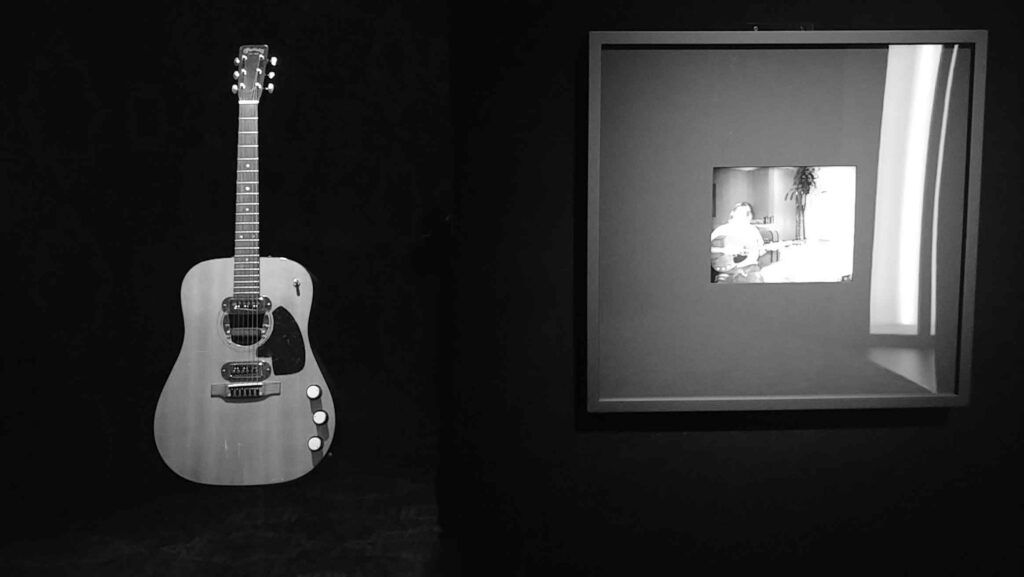
While the buyers of most high-priced instruments choose to remain anonymous, Australian entrepreneur Peter Freedman bought Kurt Cobain’s Martin D-18E for the precise opposite reaction: to gain attention.
“I want to use it to shed light on what is happening with musicians, entertainers, artists,” he told the Australian Financial Review (AFR) in October 2020, after the coronavirus pandemic had shuttered the arts industry. “I’m on the other side of the mic, I’m lucky, I’m making dough.”
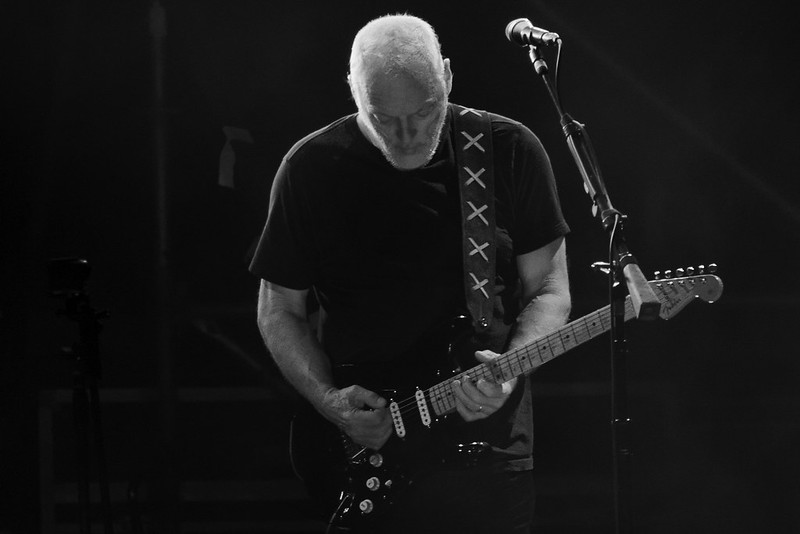
Freedman paid $6 million for the Martin D-18E Cobain played on MTV Unplugged in November 1993, just five months before his death. The result, nearly four times the pre-sale estimate of $1.5 million, stood as the most expensive guitar ever sold until David Gilmour’s Black Strat fetched $14.55 million at the Jim Irsay Collection auction in 2026.
Freedman knew what he wanted. When the bidding reached $5 million (well above the previous record guitar sale), he upped his bid by $1 million to win the auction.
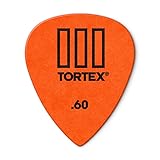
The D-18E is an unusual instrument. Martin fitted it from the factory with DeArmond pickups — a short-lived experiment the company never repeated — making it one of the rarest models in the Martin catalogue. Cobain customised both the guitar and its case before the MTV appearance. The case contained three Dunlop Tortex 60mm picks, a partial set of Martin Phosphor Bronze strings, and a small velvet pouch with silvertone lapel pins.
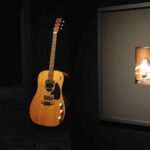
Freedman turned up for that AFR interview at a Sydney restaurant carrying the guitar in the same case. I had the chance to see it when it was later put on exhibition — photos here.
- Tone and feel of Tortex
- Speed and precision of Jazz III
- Available in standard Tortex gauges

- PROFESSIONAL GUITAR STRINGS: Discover your guitar’s true voice. These strings are designed with…
- HIGH-QUALITY DESIGN: Made from 92/8 phosphor bronze, these acoustic strings feature top-quality…
- SUPERIOR PERFORMANCE: Best for rigorous practice and performance, our phosphor bronze strings can be…

Eric Clapton’s 1939 Martin 000-42: $4,101,000 (2026)
The guitar Eric Clapton played on his 1992 MTV Unplugged performance sold at Christie’s in March 2026 for $4,101,000 — more than five times the $791,500 it fetched when it first went under the hammer in 2004. (The MTV Unplugged performance also featured Clapton playing a 1977 Juan Alvarez classical guitar which sold for $101,600 in May 2024 – one of the highest prices paid for a classical guitar in history.)
The sale was part of the Jim Irsay Collection, which set a new benchmark for guitars being auctioned, including David Gilmour’s Black Strat all-time record. The MTV Unplugged album — with Clapton and this pre-war Martin on the cover — won six Grammy Awards and sold 26 million copies worldwide.
The 000-42 can be heard on acoustic versions of Layla, Before You Accuse Me and Old Love, as well as early takes of My Father’s Eyes and Lonely Stranger. Clapton liked the guitar’s short-scale neck so much he used it as the basis for his own Martin signature model, the rare 000-42EC. Just 113 pre-war examples were built.
“This is an incredible guitar,” Clapton said ahead of the original 2004 auction. “I would never be able to part with it if I didn’t have one as good, which I’ve kept.”
John Lennon’s Framus ‘You’ve Got to Hide Your Love Away’ Hootenanny 12-String: $2,880,000 (2024)
John Lennon’s Framus Hootenanny 12-string — the guitar he used to record You’ve Got to Hide Your Love Away — sold at Julien’s Auctions in May 2024 for $2.88 million, nearly three and a half times its $800,000 high estimate and surpassing the $2.4 million paid for his Gibson J-160E in 2015 (see entry below).
The Framus Hootenanny was a modest German-made instrument. Lennon used it in the mid-1960s, when 12-string acoustic tones ran through the heart of the British Invasion sound.
The guitar made its recording debut during the 1965 Help! sessions where it was photographed in the hands of both Lennon and Harrison. Producer George Martin’s handwritten notes confirm that the Hootenanny was used by both Lennon and Harrison on the song You’ve Got to Hide Your Love Away.
It is also featured on It’s Only Love, I’ve Just Seen a Face, and Help!. On Rubber Soul it can be heard on Girl, as well as George Harrison’s parts on Norwegian Wood (This Bird Has Flown). It’s featured in photos from the Beatles Monthly Magazine, and is seen being played by Lennon in the movie Help! when The Beatles perform You’ve Got To Hide Your Love Away.
John Lennon’s Gibson J-160E Acoustic-Electric: $2.4 Million (2015)
John Lennon owned his Gibson J-160E for only two years in the early 1960s before it was stolen, but he used it to write and record some of the most famous Beatles songs of the era.
It disappeared after a London concert in 1963, resurfaced in a San Diego music store four years later, and sat unidentified for another four decades. In 2015, 52 years after it was pinched, an anonymous buyer paid $2.4 million for it, then a record for a Beatles instrument. The video of This Boy above is one of the last times it was played by Lennon.
Lennon used it to record Love Me Do and to co-write I Want to Hold Your Hand and Please Please Me with Paul McCartney. He and George Harrison had ordered identical J-160Es in 1962 for about £161 each, referring to them as “the jumbo.”
“George and I often took a jumbo home with us, so nobody noticed until the end of the season that one was missing,” Lennon told The Beatles Monthly Book. “A week or two afterwards I asked Mal [Evans, the group’s roadie] where he’d put my jumbo. It was only then that we realised the guitar had been pinched, at Finsbury Park. No, I never got it back.”
It was identified as Lennon’s guitar in 2008 by Beatles expert Andy Babiuk (the author of Beatles Gear: All the Fab Four’s Instruments from Stage to Studio) who traced the serial number to the original hire-purchase receipt still in Gibson’s archives and compared its wood grain.
The $2.4 million result held as the record for a Beatles guitar until Lennon’s Framus Hootenanny sold for $2.88 million in 2024 — see entry above.
David Gilmour’s 1969 C.F. Martin D-35: $2,393,000 (2026)
Pink Floyd’s David Gilmour bought this Martin D-35 from a musician on a street outside New York’s Manny’s Music store circa 1971 — the same year he purchased his Black Strat only a block away.
It became his primary studio acoustic for both Pink Floyd and his solo work for nearly five decades. When asked by Guitar Player magazine in 2003 which of his guitars had the most songs attached to it, Gilmour’s answer was immediate: the Martin D-35. “I used it on Wish You Were Here, and I’ve been using it ever since.”
The D-35 first sold for $1,095,000 to Indianapolis Colts owner Jim Irsay in 2019 — more than 50 times its $10,000–$20,000 estimate, and a new auction record for a Martin guitar. When Irsay’s collection returned to Christie’s in March 2026, the D-35 sold again for $2,393,000 — more than double its 2019 price, against an estimate of $800,000–$1,200,000.
The guitar can be heard across the full breadth of Pink Floyd’s golden era. It featured during pre-production for The Dark Side of the Moon in 1971, appeared on Obscured by Clouds in 1972, and became most closely identified with the acoustic title track of Wish You Were Here in 1975. Gilmour also used it during sessions for Animals at Britannia Row Studios in 1976, and returned to it for his 2006 solo album On an Island.
When asked by Sue Lawley on BBC Radio 4’s Desert Island Discs what his luxury desert island item would be, Gilmour replied: “Well to me it’s not a luxury, it’s an essential. I need to take my guitar with me, my acoustic Martin D-35 guitar: because life is impossible without a guitar.”
The D-35 guitar can also be heard on the Wish You Were Here album’s second track, Welcome to the Machine, as well as the opening riff of Wish You Were Here itself (though that riff was composed on the Martin D12-28 12-string that Gilmour bought in 1974, which sold for more than half a million dollars at the same 2019 auction).
Paul McCartney’s first guitar, a 1950s Rex acoustic: $615,203 (2015)
John Lennon is not the only member of the Beatles to make this list of most valuable acoustic guitars. The Rex guitar that Paul McCartney first learnt to play sold at auction for £330,000 in 2015 – more than three times its estimate.
The guitar was sold by McCartney’s school-friend Ian James, who initially lent the guitar and helped teach McCartney how to play.
McCartney brought the guitar to a fete where he met Lennon, then playing with The Quarrymen, and impressed him with a few chords, sparking one of the most famous musical partnerships in history. (The guitar Lennon was playing that day was sold at auction for £155,500 in 1999.)
Two photographs were included with the sale: McCartney playing the guitar today and a photo (taken by McCartney) almost 50 years ago of a young Ian James with the instrument.
A note written by McCartney said: “The above guitar, belonging to my old school pal Ian James, was the first guitar I ever held. It was also the guitar on which I learned my first chords in his house at 43 Elswich Street, Liverpool 8.”
Roy Rogers’ 1930 Martin OM-45 Deluxe: $554,500 (2009)
Leonard Franklin Slye paid $30 for this guitar at a California pawn shop in 1933. He had no idea it was the very first OM-45 Deluxe Martin ever built — the prototype for one of the rarest and most coveted models the company ever produced. By the time the guitar sold at Christie’s for $554,500 in 2009, more than twice its high estimate, Slye had long since become cowboy legend Roy Rogers.
Martin built just 15 OM-45 Deluxes in 1930, originally retailing at $225. The model is considered among collectors to be Martin’s most ornate and visually spectacular guitar, with diamond and snowflake inlays on the ebony fingerboard, abalone throughout, tortoiseshell pickguard with floral detail, and banjo-style gold tuners with mother-of-pearl buttons.
Rogers used it throughout his stage and film career before retiring it in the mid-1940s, by which point it had become synonymous with his persona.
The guitar was auctioned by the Roy Rogers-Dale Evans Museum in Branson, Missouri. Martin honoured the instrument with a limited-edition replica in 2006, produced in a run of 84.
David Gilmour’s 1971 C.F. Martin D12-28: $531,000 (2019)
David Gilmour’s 12-string Martin D-12-28 sold at auction for $531,000 in 2019 as part of a larger collection which brought in $21.5 million. It was expected to sell for just $5000-$10,000.
It was the guitar Gilmour used to write Wish You Were Here, and can also be heard underneath the main riff played on his Martin D-35 (see entry above). The 12-string was recorded to sound like it was being played on a radio, with the fuller sounding D-35 played by a kid at home joining in.
Rolling Stone magazine has ranked the song among the greatest of all time.
“Every time I listen to the actual original recording, I think, ‘God, I should have really done that a little bit better’,” Gilmour told Paul Rappaport in September 2011. “It wasn’t supposed to be too slick… and it wasn’t.”
The guitar can also be heard on the Wish You Were Here album’s second track, Welcome To The Machine, before appearing again four years later on the 1979 concept album The Wall, and on the song Paranoid Eyes for the 1983 anti-war concept album The Final Cut.
1939 Martin D-45: $393,700 (2026)
The 1939 Martin D-45 is among the most coveted acoustic guitars ever built, as well as one of the rarest. Martin produced just 91 D-45s before halting the model in 1942, when wartime material shortages forced the company to suspend its flagship line. A 1939 example sits at the very end of that run.
This guitar sold as part of the Jim Irsay Collection at Christie’s in March 2026 for $393,700 — above its $250,000–$350,000 estimate — after Irsay acquired it from Gruhn Guitars in 2013.
The D-45 was Martin’s most expensive model: spruce top, Brazilian rosewood back and sides, bound ebony fingerboard, and the company’s most elaborate abalone inlay work. It is, in the vintage guitar world, about as close to a grail instrument as exists.
Unusually, no famous player was attached to this sale. It’s the reason that Eric Clapton’s 000-42 — a less prestigious Martin model from the same era — sold for more than ten times as much at the same auction.
Janis Joplin’s 1953 Gibson J-45: $381,000 (2026)
The guitar Janis Joplin used to perform Me and Bobby McGee for the first time sold at the Jim Irsay Collection auction at Christie’s in March 2026 for $381,000 — nearly four times its highest estimate of $100,000.
The story of how the song reached Joplin is one of popular music’s great chains of coincidence. In the fall of 1969, her close friend Bob Neuwirth was at manager Albert Grossman’s office when Canadian singer-songwriter Gordon Lightfoot played him an unknown song he’d just learned from a Nashville writer named Kris Kristofferson. Neuwirth learned it on the spot. That evening, waiting in Joplin’s hotel room while she got ready for dinner, he picked up her J-45 and played it. Joplin fell in love with it immediately, learned it, wrote it down, and performed it on stage just days later.
Her first public performance of Me and Bobby McGee was a spur of the moment performance at Nashville’s Fairgrounds Coliseum on December 16, 1969. A front-page review in The Nashville Tennessean the next morning described her strumming “an unamplified country guitar” and singing with “apparent respect, even lilting it with some of the typical country twang.”
Joplin recorded the song in Los Angeles just days before her death in October 1970 at age 27. Released as a posthumous single, Me and Bobby McGee became her first and only number one hit and her signature song.
The J-45 was one of only two acoustic guitars in Joplin’s possession when she died. It was given to Neuwirth — the man who had introduced her to the song — with the approval of the Joplin estate.
Neuwirth went on to play it on stage during Bob Dylan’s 1975–76 Rolling Thunder Revue, and tour technician Arthur Rosato has said that Dylan himself may have picked it up in the dressing room on occasion. Neuwirth owned the guitar until his death in 2022. It later spent three years on display at the Rock & Roll Hall of Fame in Cleveland.
Elvis Presley’s 1969 Gibson Dove acoustic: $334,000 (2016)
In 1969, Vernon Presley walked into Guitar City — the store across the street from Graceland — and bought his son a Gibson Dove to mark Elvis’s achievement of a black belt in karate. He had it customised: the finish changed to ebony black, Elvis’s name inlaid on the fingerboard by craftsman Randy Wood at Gruhn Guitars in Nashville, and a Kenpo Karate Association decal affixed to the body.
Elvis played it in dozens of concerts between 1971 and 1975. Its most significant appearance was the January 14, 1973 Aloha from Hawaii concert — the first televised performance to be beamed around the world by satellite, watched by an estimated 1.5 billion people. The guitar shows heavy stage wear: scratches and scuffing on the back from Elvis’s rhinestone-studded belts and jumpsuits.
In July 1975, at a concert in Asheville, North Carolina, Elvis handed it to a 21-year-old fan in the front row. That fan held it for four decades before consigning it to auction at Graceland in 2016, where it sold for $334,000 — well above its $200,000–$300,000 estimate.