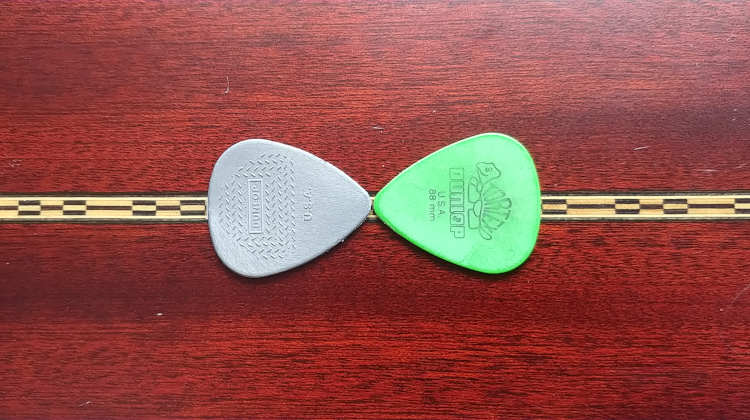
The flexibility of nylon guitar picks allows for moderately faster picking but Tortex guitar picks produce a more defined attack and sustain, according to tests by the Victoria University of Wellington.
The tests were conducted by the Engineering department as part of an experiment to build a robotic bass playing arm that involved testing seven Dunlop Tortex and Dunlop Nylon picks to pluck the strings.
The 0.46mm nylon pick allowed for the fastest plucking speed of 13 notes per second although the stiffer 0.5mm Tortex was only slightly slower at 12 notes per second.
Graph 1: Guitar pick speed comparison
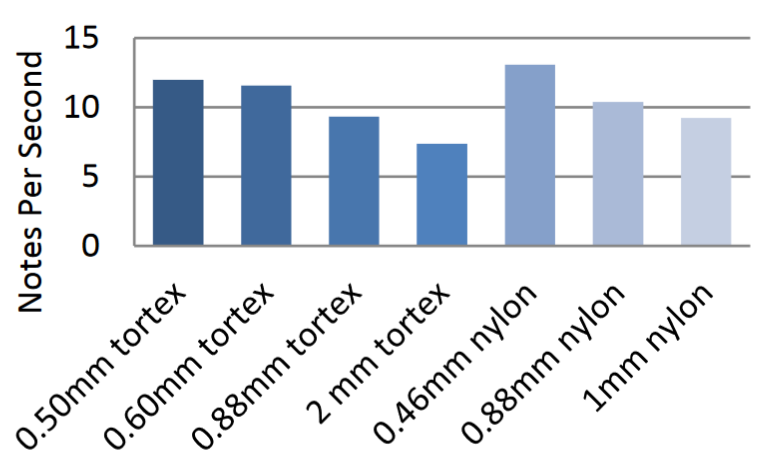
“This is due to the flexibility of the nylon, allowing the pick to push past the string while offering less resistance than the stiffer Tortex picks,” the study authors’ wrote. The study also compared thicker picks Tortex picks (0.5mm, 0.6mm, 0.88mm, 2mm) and Nylon picks (0.46mm, 0.88mm and 1mm).
No products found.
However, these results were produced by a mechanical arm using the same force and pick angle – in practice, a guitarist is likely to make playing adjustments depending on the pick used.
Any guitarist playing certain phrases at high speed is also likely to use some form of economy picking (sometimes called directional picking or continuous picking) rather than alternate picking. This requires tilting the top of the pick slightly towards the direction of the sweep to reduce drag (for example, if a guitarist was playing three notes on each of the the bass strings, they could use a continuous downstroke from the 6th string to the 5th string to the 4th string).
You can learn this technique in Chad Johnson’s book, The Guitarist’s Guide to Economy Picking: Learn to Play Fast, Lean and Clean with the Picking Techniques of the Masters.
No products found.
The small difference in speed the Victoria University of Wellington tests revealed is likely less important than the difference in sound quality produced by the different picks.
“While the 0.46 nylon pick can pluck the fastest at 13 notes per second it does not strike the string with a defined attack [the initial run-up in sound levels from nil to peak]. As it is flexible, it simply bends past the string, not giving a defined attack sound. This attack portion of a pluck is important from a musical standpoint as it clearly defines the start of the note.”
Graph 2: Attack and sustain produced by a 0.46mm nylon pick versus 0.5mm Tortex pick
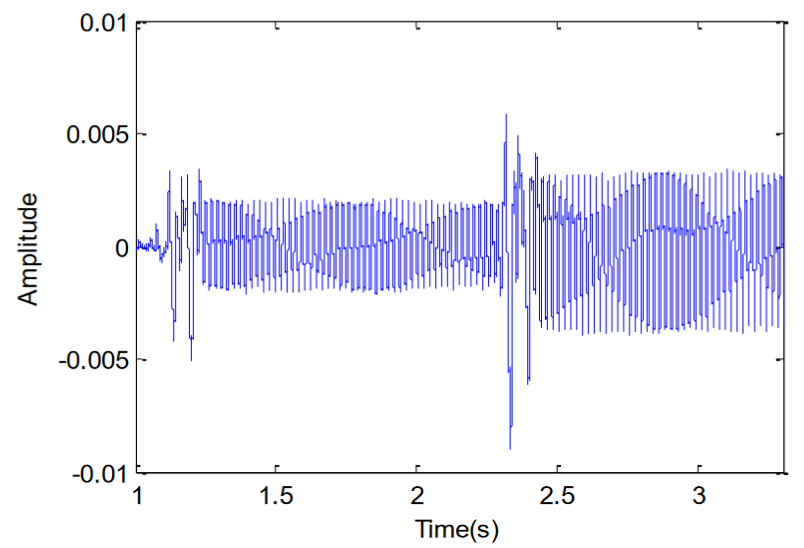
The study settled on the 0.5mm Tortex guitar pick as its preferred robotic arm plucking mechanism due to the overall combination of stronger response and high speed.