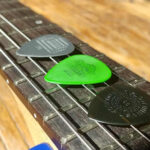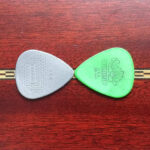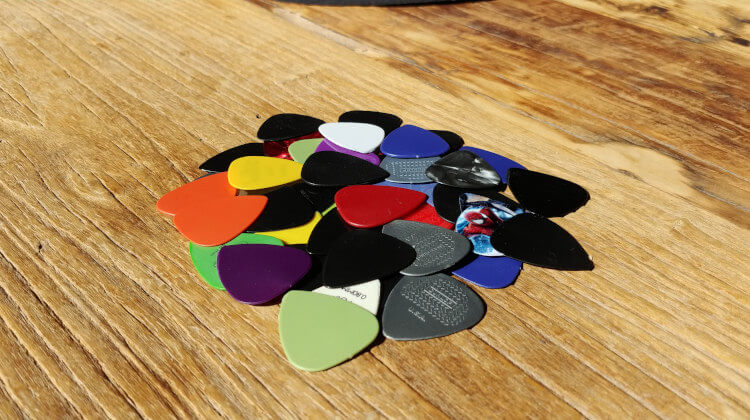
Guitar picks come in all shapes and sizes but there is one that stands above all others: the 1-inch triangular-shaped No. 351 plectrum.
The No. 351 pick is today often associated with Fender but it was D’Andrea that first used celluloid to design the famous guitar pick in the 1920s.
Their innovative pick designs using celluloid plastic helped usher in a new era for the guitar itself, which was more commonly used as a rhythm instrument played finger-picking style.
The first picks
Musicians have used different devices to pluck stringed instruments for centuries, including feather quills and ostrich feathers. The natural world continued to provide the raw material for plectrums with thumb and finger picks made from Atlantic hawksbill sea turtle shell (referred to as tortoise shell) used to play the more popular mandolin and tenor banjo up until the 1920s.
But tortoise shell picks were prone to snapping, as well as being expensive given their inherently limited supply. (Production of tortoise shell picks were phased out completely in the 1970s when the hawksbill sea turtle was recognised as an endangered species.)
The creation of celluloid plastic in the 19th century provided another option. In 1922, Luigi D’Andrea bought some sheets of tortoise-shell colored celluloid and mallet dies to make heart shaped decorations for the tops of powder puff boxes.
His son Anthony saw that they resembled an uncle’s tortoise shell mandolin pick and together they sold a cigar box of the little hearts to New York music store G. Schirmer & Son Company for $10, according to Will Hoover’s book Picks!
The No. 351 pick was born, but it was still several years before it would take off in popularity.
No products found.
The first guitar hero: Nick Lucas brings picks to the masses
In the early-1920s, Nick Lucas became the first person to record guitar solos for the Pathe label – including the song “Pickin’ the Guitar” – and quickly became a star. His distinctive singing style and steel-string guitar played with a pick put the instrument centre stage.
In 1929 he starred in the film Gold Diggers of Broadway and had a huge hit with the song “Tiptoe Thru the Tulips”. The video below shows Nick Lucas playing two songs: “Picking The Guitar” and “Teasing The Frets”.
His success led to the launch of the Gibson Nick Lucas Guitar, followed by the Nick Lucas guitar pick in the 1930s. D’Andrea manufactured the No. 351 which bore Lucas’ name – the first guitar pick to bear an imprint. The classic shape was never patented, and other manufacturers began launching their own similarly shaped picks also made from celluloid.
However, D’Andrea continued to dominate the pick market in the following decades, making wholesale picks that were branded and sold by Gibson, Fender, Martin and Gretsch.
In 1955, D’Andrea struck a momentous deal with Fender to manufacture the Fender Medium No. 351 branded with the Fender logo.
Lucas’ popularity eventually faded as musical styles changed and the guitar pick is no longer associated with his name although it’s standard shape and popularity lives on.
No products found.