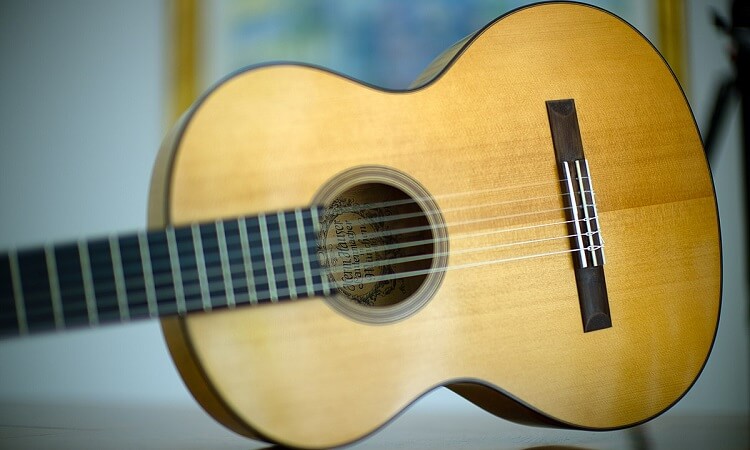
Legendary classical guitarist Andrés Segovia was a fan of Hermann Hauser’s guitars. He was less keen on the gut strings he had to use on them.
“They were hardly ever perfectly in tune, the gut strings became unravelled and the basses lost their resonance,” he wrote in a 1955 edition of Guitar Review.
Animal gut’s strength and flexibility (typically from lambs) had been used to string instruments for centuries. Yet they would also regularly break, including during Segovia’s concerts.
“If the lamb who had donated his intestines was too young, the strings would lack the resistance and break. If the lamb was too old the strings would lack elasticity and wouldn’t stretch far enough or else would have tendency to go sharp in pitch. If the pastures that year had suffered from either too much rain or too much sun, these factors were also reflected in the quality of the sound and the durability of the strings.”
Andrés Segovia, Guitar Review, no. 17 (1955)
The popularity of gut strings quickly faded after the DuPont company created strong, low-cost nylon in the 1930s. Yet the feel and sound of gut strings means they retain a niche place among classical guitarists today.
By way of contrast, many harp players still prefer the sound of gut strings, despite their temperamental behaviour, and consider nylon a beginner’s string. Why don’t guitarists feel the same way?
Why gut string sounds different than nylon
Any fundamental note played on the guitar also produces certain overtones that can make the sound either bright, warm, or even inharmonic.
Gut, nylon and fluorocarbon strings all have a threshold where these overtones are increasingly damped, potentially making the sound unmusical. This usually only becomes problem on the upper frets of the third string of a standard tuned guitar.
Research by Cambridge Professor Jim Woodhouse and Nicolas Lynch-Aird has shown that gut strings (as well as fluorocarbon strings) have a higher damping threshold than nylon. In other words, these strings have greater frequency headroom.
This is an issue for harpists because they use longer, thicker strings than guitarists. Longer strings require higher tensions, and this brings nylon very close to its damping threshold.
“Nylon suffers from this problem to a greater extent than gut, and so these results strongly suggest that gut strings will sound brighter than nylon strings over the entire range of the harp,” Woodhouse and Lynch-Aird wrote in their research paper, Choosing Strings for Plucked Musical Instruments.
Brandon Acker, in the video below, recently tested gut strings on a theorbo (a type of lute) and said there’s “a warmth and resonance to the gut strings that synthetic strings, in my opinion, just don’t have”.
This tallies with the research as theorbo strings are much longer (and probably higher tension) than for a standard guitar, which means the damping threshold is more strongly at play.
Modern gut strings
As Segovia pointed out decades ago, the quality of gut strings varies enormously. That variation also comes up in scientific tests today, such as string stiffness (Young’s modulus), when compared to nylon and fluorocarbon.
“The twisting and polishing processes are carried out by hand, on each length of string individually,” according to Woodhouse and Lynch-Aird. “Some variation of detailed structure along the length of the string is bound to occur, and this may lead to spatial variation in the complex Young’s modulus.”
Gut strings are more sensitive to humidity, and so require more frequent tuning. They also have a lower breaking point than nylon. Many antique guitars were built with a smaller scale than modern standards, which placed less strain on the strings. Some guitarists tune down by a semi-tone when using gut strings to make them last longer.
Italian string manufacturer Aquila has attempted to replicate the gut sound with Nylgut®, which has the same mean specific weight as gut.
As always, what works for each guitarist is the combination of many factors, including their playing style, their instrument, and the tone they wish to achieve.