• Skip to main content
  • Skip to secondary menu
  • Skip to footer

Inside Guitar

The science and soul behind six strings

  • Strings
  • Guitar Picks
  • Guitar Construction
  • Sheet Music
  • Guitar Reviews

Why guitar reviews aren’t always right: trust your own ears, not someone else’s

A group of skilled classical guitarists were unable to consistently rank 12 instruments from best to worst even after playing them, according to a new study.

The surprising result raises questions about the role of subjectivity when attempting to assess an instrument’s sound.

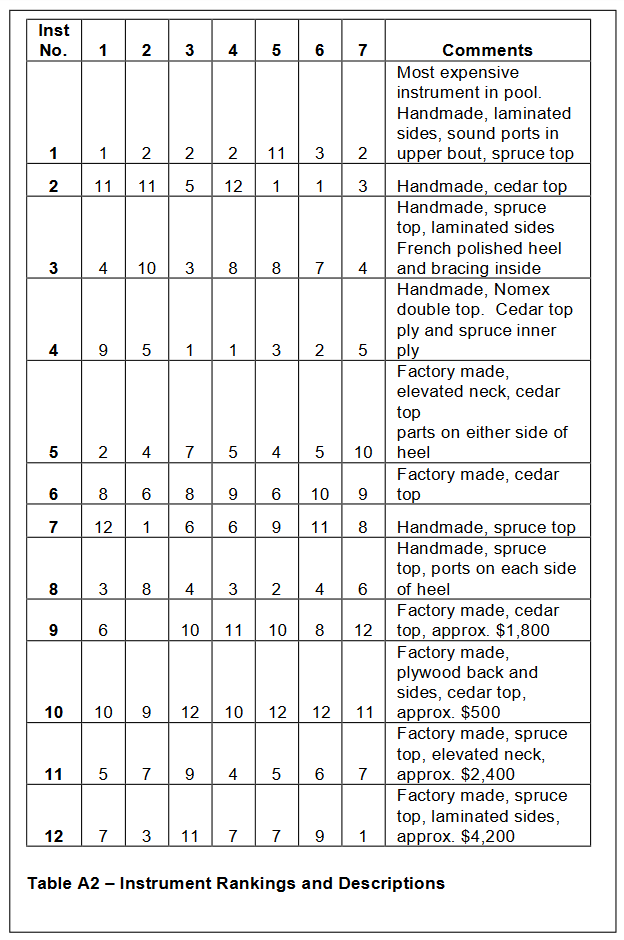
“There was rough consensus on the most and least desirable instruments, but no clear subjective result beyond that,” the authors of the study wrote.

The highest ranked guitar was a handmade model that cost several thousand dollars while the lowest ranked was a student entry level model that cost just $500.

“However, disagreements were sometimes significant and one instrument (No. 2) even got both a highest and a lowest rating from the pool.”

The study, conducted at Purdue University, called on seven students enrolled in the classical guitar program. They were given up to 40 minutes to play the guitars and rank them from most to least desirable.

The result bucks the expectations of several expert guitar luthiers, who thought skilled musicians would generally rank the instruments in similar order.

The study also measured the frequency response function of each guitar but found no correlation with the players’ rankings.

Guitarists should take two important lessons away from this study:

  • Reviews that rank musical instruments in numerical order from best-to-worst should be taken with a large grain of salt. Trust your own ears – not someone else’s.
  • Spending more money doesn’t always buy you a better sounding instrument.
The study, “Comparing Subjective and Objective Data from a Pool of Classical Guitars“, was published in the Savart Journal.

Related Posts:

  • The mahogany back and sides of an Epiphone Masterbilt R-500MNS acoustic guitar.
    How an acoustic guitar’s back and side tonewood…
  • Spruce versus cedar trees for classical guitar
    Cedar or spruce? Alhambra, Yamaha and Alvaro…
  • tree-nature-forest-wilderness-branch-mountain-100653-pxhere.com
    Why acoustic guitars are often made from spruce or cedar
  • Nylon and Tortex guitar pick head to head
    Nylon versus Tortex guitar picks: faster picking…
  • A weight rests on guitar strings illustrating string tension.
    High versus normal tension strings: the secret trade-off
  • A guitarist with poor posture.
    Why guitarists are at the highest risk of back, neck…

Footer

Advertising & Partnerships

Inside-guitar.com is a reader-supported site. If you buy a product through one of the links on our site, we may earn an affiliate commission or referral fee.

This is not a direct cost to you and helps offset the cost of running the site. Thank you for your support.

Company

  • About Inside-guitar.com
  • Contact Us
  • Cookie Policy
  • Privacy Policy

Recent Posts

  • Why capos are for more than just changing keys
  • Clip-on guitar tuners: the best choice for accuracy and speed
  • Boss Blues Driver BD-2 pedal review
  • A close-up look at Kurt Cobain’s Martin D-18E acoustic guitar

All content copyright © 2026 · All rights reserved ·