Cedar or spruce? Alhambra, Yamaha and Alvaro acoustic guitars tested
The sound of an acoustic guitar is dictated by many factors, but one of the most important is the choice of wood for the top plate. Spruce and cedar have traditionally been among the most popular due to the wood’s stiffness and low density.
A recent study compared the sound characteristics of the two materials across two groups of spruce and cedar top guitars.
The first group of three guitars (two Canadian cedar and one German spruce) were designed to the same standards other than the top material by luthier Jorge Noguera. The second group of guitars comprised an Alvaro 55 and Yamaha CG171C (both cedar soundboards) and an Alhambra 1C guitar (with a German spruce top). All guitars were strung with D’Addario EJ27N strings. (Note – the Yamaha CG182 classical guitar is the successor to the CG171 model, which is no longer made, and one step below the company’s flagship CG192 model.) All guitars were strung with D’Addario EJ27N sets.
All six classical guitars in the study, including the Alhambra 1C, Alvaro 55 and Yamaha CG171C, were tested with D’Addario EJ27N string sets.
The German spruce guitars clearly came out on top, at least in this test.
“It was found that volume and sound duration were higher in guitars with German spruce soundboard, whereas guitars with Canadian cedar soundboard presented more homogeneous sounds,” according to the study.
However, guitarists should keep in mind that every piece of wood has its own unique characteristics even within species. Meanwhile, the specific results of the test showed some interesting differences.
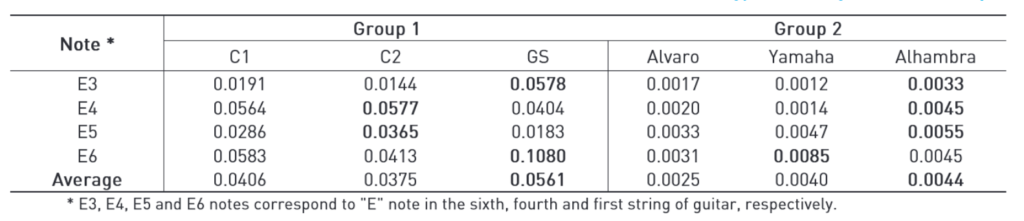
While the Alhambra and Noguera-made German spruce guitars were louder on average, this wasn’t the case for every E note tested, as shown in the table below.
Table 1: Total energy of each guitar (sound power)
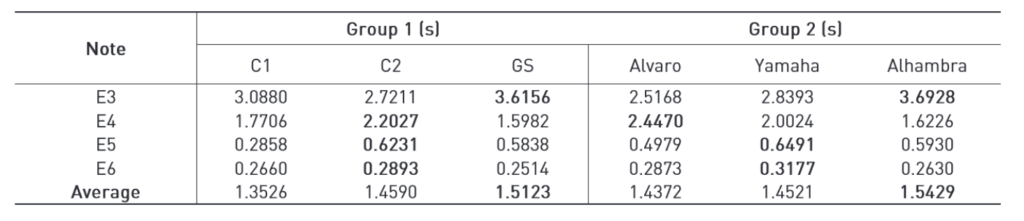
E notes played on the Alhambra and Noguera-made German spruce guitars also sounded for longer on average, but this was almost solely down to the open E on the sixth string.
Table 2: Sound duration (seconds)
The Alhambra also had the greatest timbre richness, as measured by the number of harmonics in each E note played. (Harmonics are the overtones that are also present alongside the fundamental note and help produce the characteristic sound of the guitar.) However, the Alhambra was very close to the Alvaro and Yamaha. One of the Noguera-made spruce guitars had the highest harmonics although again, all three guitars were similar.
Table 3: Number of harmonics in every note (timbre)
In other words, the quality of the sound is highly dependent on the luthier’s ability to balance the different components of the guitar (or the manufacturer’s standards), according to the report.
“Regarding timbre, changes in material were inconclusive, since similar frequency content can be seen in all the guitars of the first group and differences in the second one are not representative. Therefore, it can be assumed that timbre is related to the geometry of the guitars of this experiment or to the manufacturing process.”
The study provides some interesting insights into some well-known brands and custom built classical guitars, but the true test always comes down to the individual. No two guitars are the same – even the same make and model. The best way to find the ‘best’ guitar is to play them before making a choice.